
Residential Stucco Services in Washington, UT | Washington Elite Stucco
Washington Elite Stucco provides residential stucco services for homeowners in Washington, UT, and we have spent 15 years working on the exterior wall surfaces of houses in this valley. If you are weighing stucco against siding, brick or paint, the question in front of you is not how plaster is mixed but whether stucco suits the house you own, in the place it stands. That question has a real answer, and you can get it before you commit money to anything.
The work covers the parts of a house with a continuous finished surface: the main elevations, the gables above them, second-story returns, and where a wall meets the eaves and soffits. It covers garage and entry surrounds, chimney chases, window pop-outs, and the foundation stem walls at the bottom of the house.
A stucco house involves two decisions, not one, and homeowners often meet them as though they were the same thing. The first is the wall itself, which on almost every house here is cement stucco. The second is the finish coat that goes over it, where the choice is between a cement finish and an acrylic one. We take both further down this page and tell you which suits your walls rather than deciding it for you here.
Whichever system goes on the wall, the residential code Utah enforces sets the floor for the cement version. IRC R703.7.2 requires cement plaster over metal lath to be a three-coat job.
Then there is what the wall has to survive here. At 2,894 feet on the Mojave Desert's edge, Washington runs a long stretch of 100F days through the summer. A wall here faces long, dry heat and hard sun through that stretch, swings cold at night, and takes what monsoon storms deliver in between. Materials expand and contract through every one of those cycles, and a finish chosen for a milder place gives up years of its life to them.
We work across Washington County, including St. George, Hurricane and Santa Clara. We give you a straight answer about your own walls before you spend anything. We look at what is on the house now, tell you what it needs and what it does not, and put the estimate in front of you at no cost. Call us at (435) 319-6039 or request your free estimate through the form, and we will book a time to look at it with you.
Get A Free Estimate
What We Do
Stucco Work for Washington Homes
Stucco is the hard, mortar-like coating that covers the outside of a house, and on most Washington homes it wraps far more than the flat faces of the building.
A crew that comes to work on it deals with a set of distinct surfaces, each one sitting in a different position on the house and each one weathering at its own pace. Two things decide how large the resulting job is: which of those surfaces need attention, and how much of the building the work has to travel across. When you can see your own house as that set of parts rather than as one continuous shell, a vague worry about the outside of your home turns into something a contractor can price.
The Parts of a House That Carry Stucco
The broad faces of the building are the elevations, one for each side of the house, and they hold the largest unbroken areas of stucco. Texture and color read most clearly across them, so anything done to an elevation is what a visitor sees from the street.
Above them sit the gables, the triangular sections of wall that fill in under a pitched roof, and on a two-story house the wall returns that carry the finish up past the first floor. Neither of those is especially large, but both are high, and reaching them safely means scaffolding rather than a ladder, which is why the cost of that work follows access rather than square footage.
Where the wall stops and the roof begins, the finish has to hand off cleanly to the overhanging edge of the roof and the underside panel beneath it, a junction called the eave and soffit transition.
Water runs off the roof at that line, so it is a place worth looking at closely on your own house. Lower down and closer to eye level are the garage and entry surrounds, the walls framing your garage door and front door. They cover modest square footage and take more looks per day than any other part of the exterior.
Three other elements sit apart from the main faces. A chimney chase is the boxed enclosure that carries a chimney's pipe up past the roof, and because it stands free of the building it takes weather on all four sides instead of one. Window and door pop-outs are the raised bands that project a little way out around your openings, framing them and shedding water away from the glass and the door.
A foundation stem wall is the strip of concrete between the soil and the framed wall above, and stucco often carries down onto it to tie the base of the house into the rest of the finish. That coating is stopped deliberately short of the ground, leaving a visible gap of bare concrete near the soil, because a finish run all the way down into damp earth draws moisture up behind itself. What holds all of this together behind the surface, the metal lath and the coats of cement stucco laid over it, is covered on our stucco installation page.
Whole-House Work Versus a Single Elevation
A single elevation is a legitimate scope, and we quote it as one. One wall costs less to refinish and takes less time than going around the building. The usual candidates are the south and west faces, which take the heaviest sun load in this climate and age faster than the sides that spend the afternoon in shadow.
What you trade for that saving is uniformity: a fresh finish placed beside a wall that has weathered for years rarely disappears completely, because the older surface has faded and gathered its own character while the new one has not. We will tell you before we start where that line is going to fall and how visible we expect it to be, so the result is something you agreed to rather than something you discover. How closely a patch can be matched to an aged wall is a repair question, and our stucco repair page covers it.
Going around the whole exterior avoids that line altogether. One setup, one batch of material, one texture and one cure window across every exterior wall leaves the house a single continuous surface when the crew drives away. The economics push the same way more often than owners expect, because most of what a stucco job costs before any finish goes on barely shrinks with the scope.
Scaffolding still has to be built, windows and doors and landscaping still have to be masked, and the site still has to be protected whether we are working on one wall or four. Two or three elevations at once therefore cost far less per wall than the same walls done one at a time across separate visits. Weigh that before you narrow the job to the one side that bothers you most.
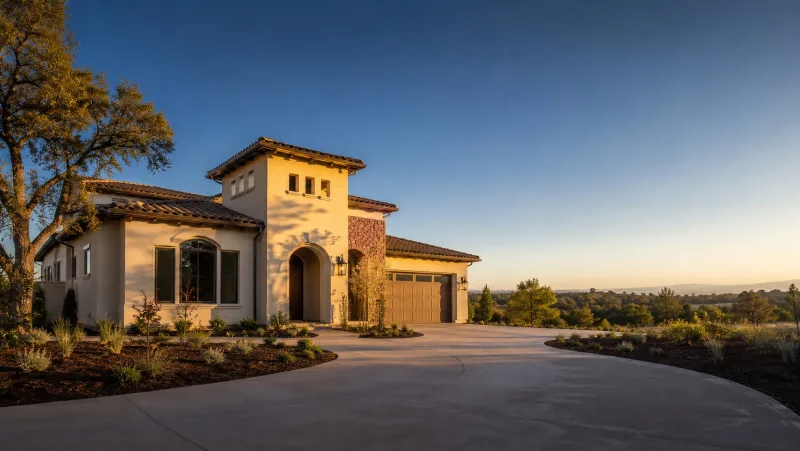
Which Residential Stucco Services a Washington Wall Needs
Residential stucco services cover repair, recoating, replacement and new application, but almost nobody calls a stucco contractor and asks for one of those by name. You call because you can see something: a crack running from a window corner, a chalky patch that will not match after painting. It might be a soft spot under the eave, or a stain that keeps coming back on the same wall. A symptom on its own does not name the work. It only tells us where to look.
What names the work is the symptom together with the system underneath it. The same hairline crack means one thing on a hard cement coating packed over wire and another on a thin flexible skin bonded to board, because the two are built differently and they fail differently. So the first question a residential stucco contractor should answer at your house is what the wall is made of, and the answer to that starts before anyone touches it. Where your house sits in Washington, and roughly when it went up, narrows the field considerably.
Washington is the second largest city in Washington County, with a population of 27,993 at the 2020 census, and that growth arrived in distinct waves rather than all at once. Each wave built differently. Knowing which wave your street belongs to tells us the likely exterior wall system before we arrive, and what we are checking for when we do.
Reading a Wall by Its Build Era and Subdivision
Residential stucco services start from what is already on the wall, and the recipe for those layers changed over the decades that Washington was built.
The city started as a cotton-mission settlement in 1857, and the oldest houses in Old Town Washington go back to that early core, more than a century before the subdivisions on the edges of town existed. Coral Canyon, Green Springs and Washington Fields belong to the growth era instead. Houses there were designed with stucco from the beginning rather than having it added later, which usually means a consistent system across the whole exterior.
Older cement stucco walls here are typically three coats of cement-based material built up over metal lath, a wire mesh nailed to the wall that the coating grips. It is a thick, rigid, mineral surface, and it behaves like one.
Some walls carry an acrylic finish instead, which behaves differently when it gets wet, so a wet spot on one is not the same problem as a wet spot on the other. A minority of walls carry EIFS, which is not a finish coat at all but a whole wall assembly with insulation built into it. Our remediation work identifies and addresses those.
None of this replaces looking. Your build era predicts the system on your exterior wall; only inspecting it confirms which one you have, and houses get re-coated, extended and patched over the years in ways no map records. That is why we sound a wall before quoting, tapping across the surface and listening for where the coating has separated from what is behind it, a hollow note where the rest rings solid. You get a diagnosis first, tied to what is on your particular wall, and the job it points to follows from that.
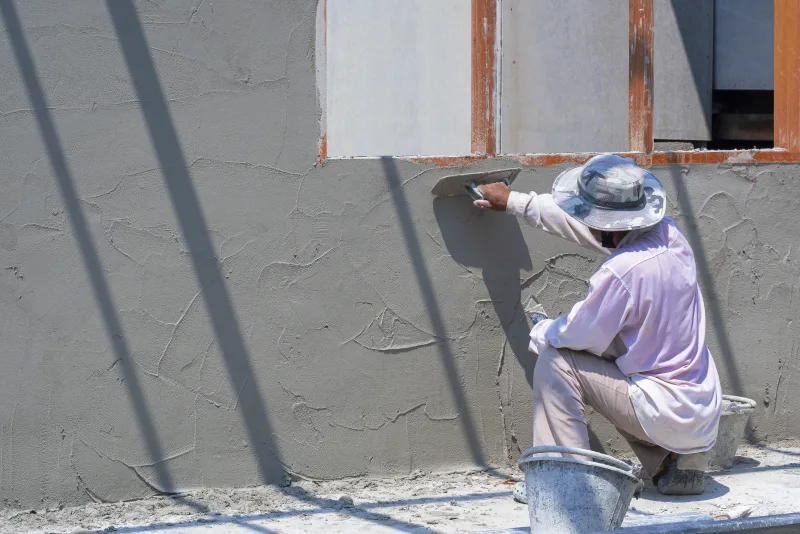
Choosing a System for a Desert Home
Two things get called a stucco system in this desert climate, and separating them is what makes the decision straightforward. The wall is one thing: on a framed house here it is cement stucco, and there is rarely a reason for it to be anything else. What gets troweled on top of it is the other, and that is the part you choose. Both are described below.
The exterior wall's exposure decides the finish, not preference. That means how the wall faces the sun, what the monsoon throws at it, and how far it moves between the afternoon high and the overnight low.
Here is the short version, and the two subsections below explain why. A cement finish suits a wall that is shaded, sheltered or already cracking, because it can be cut out and rebuilt with the same material years later. An acrylic finish suits a south or west elevation taking full afternoon sun, because it holds its color under ultraviolet light better and flexes with the daily movement instead of splitting. That choice also governs what a repair looks like a decade from now, so deciding on purpose at the start is cheaper than discovering the decision in the middle of one.
Cement Stucco, and What It Asks of a House
Cement stucco is a mineral coating made from portland cement, sand and water, mixed on site and worked onto the wall in a wet state. It does not dry the way paint dries. It cures, which means the cement and the water react chemically and the wall hardens into something closer to stone than to a coating. That single difference explains most of what follows.
What you get from a mineral wall is durability of an unusually plain kind. Cement stucco is non-combustible, and it goes onto an exterior wall as one continuous surface. It also stays repairable across a long ownership, because the material that fixes it is the material it is made of.
Cement, sand and water are still cement, sand and water in twenty years, and a competent hand can cut out a damaged area and rebuild it with the same mix rather than hunting for a discontinued product. Utah enforces the International Residential Code, and section R703.7.2 of that code sets three coats over metal lath as the standard for this kind of wall, so the assembly under your finish is a known quantity rather than one contractor's preference. How those coats go on belongs to our installation page; what matters to the choice is that the requirement is fixed and the same for everyone.
The demands run the other way as well. A cured cement wall is rigid, so it reports the small movements a house makes as the ground and the framing shift rather than hiding them. The other demand is on the calendar.
Cement stucco is a wet trade, and the wall needs time to cure properly before the next stage of work touches it. Heat shortens the window in which the mix stays workable and pulls water out of the wall faster than the cure wants, so the schedule has to allow for the curing rather than race it. When we plan your job, that time is built into the dates we give you instead of being squeezed out of them.
Acrylic-Finished Systems, and What They Are Not
An acrylic finish is a colored topcoat, bound with acrylic resin rather than cement, that goes over a hard coat, meaning the cured cement stucco wall underneath, as the outermost layer you see and touch. Its two useful properties follow from that binder. It holds its color under ultraviolet light better than pigment mixed into cement does, which matters on the elevations that take full afternoon sun. It also flexes a little, so small movement in the wall beneath tends to be taken up by the finish instead of splitting it.
An acrylic finish by itself is not EIFS. The two get confused because both are sold under the words synthetic stucco, and the confusion is worth clearing up because they are not the same category of thing. An acrylic finish is a finish material, a surface layer.
EIFS is a complete insulated cladding system, a different category of thing altogether, and it manages water on a wholly different principle from a hard coat. Calling an acrylic finish a kind of EIFS misdescribes what EIFS is. We handle EIFS questions on our remediation page, where the subject gets the room it needs.
The practical consequence for you is that the word on a listing sheet or in a previous owner's paperwork does not settle what is on your house.
You often cannot tell an acrylic finish from a cement finish, or either from an insulated system, by looking at the wall from your driveway, and a photograph is worse than standing in front of it. That is why we identify the system at the wall itself, on your property, before we quote anything. Once we know what is there, the repair, the recoat or the new system can be matched to it, and to the exposure that particular elevation lives with.
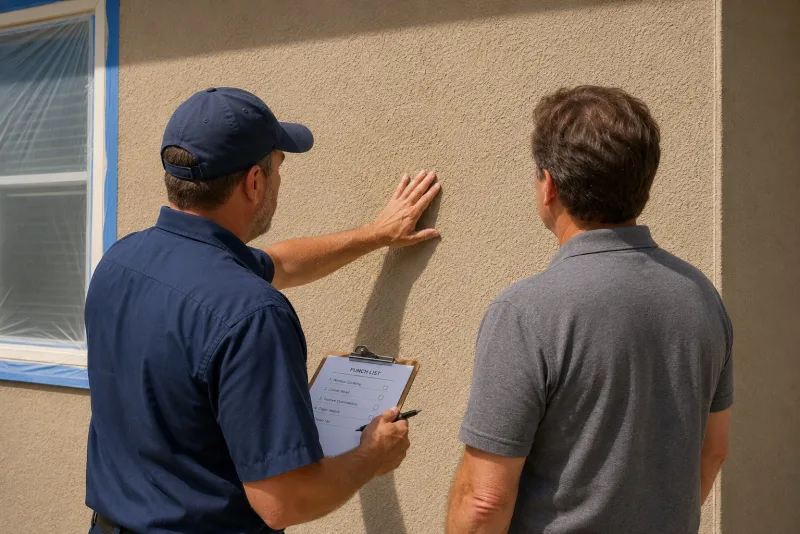
The Honest Case For and Against Stucco Here
This climate treats stucco well, and even so, stucco is a poor fit for some houses. You deserve to hear which one yours is before you commit, not a year after the crews pack up. So you get both sides here. A reader who is told only the good things has no way to judge, and you should be able to judge.
What Stucco Does Better Than the Alternatives in This Climate
Stucco earns its place on a desert house on grounds you can check, and the first of them is that it will not burn. The coating is mineral, closer to mortar than to anything manufactured in a plant, so a wall finished this way gives a wind-driven ember nothing to catch on. On a lot ringed by dry brush, that matters more than any appearance argument.
The same mineral makeup explains how the wall behaves through a long, hot summer. Panelled claddings are fastened to the house at intervals, and every fastener is a point where the panel expands, contracts and works against its own fixing year after year.
Stucco is one continuous coating bonded to the wall, so heat has far less to pull against. It also runs unbroken across a whole face of the building, with no lap lines and no repeating pattern of fastener heads, which is why a stucco elevation looks the same at ten feet as it does at fifty.
Wear is slower to show for a second reason. We can mix color into the finish coat itself rather than paint it over the top, so the color goes right through the material instead of sitting on the surface as a film.
A knock that scrapes a painted wall exposes a different color underneath; the same knock on an integrally colored finish takes off material that matches what is behind it. Sun does fade the surface over years, and the drawback section below is honest about what that costs you, but a faded wall is a wall that has aged, not a wall that has failed.
Longevity follows from all of it. Published national siding guides put a cement stucco exterior finish at fifty to a hundred years of service life when it is maintained, against twenty to forty years for vinyl. The comparison is the point here, not the number on its own. Whichever figure your house lands on, stucco is competing on a different timescale from the panelled alternatives. You are choosing between one exterior that a later owner will still be living with and one that will be replaced during that time.
The Real Drawbacks, Stated Plainly
Stucco cracks. A house moves a little with the seasons and the soil beneath it, and a rigid coating bonded to a moving wall shows hairline cracking sooner or later, most often above openings and at corners.
That is the material doing what it does, not a sign that something has gone wrong. An owner watches those cracks, and a contractor fills and refinishes the ones that have opened enough to let water in. No stucco wall stays crack-free, and a wall that has never been looked at is the one to worry about.
Repairs also show. A finish that has spent years under desert sun load is not the color it left the mixer, so a fresh patch beside it is visibly newer even when the texture is matched well.
Where the fading is too far gone to disguise, recoating the whole face is the answer rather than patching it.
Water that gets behind the coating is the drawback that costs the most. Stucco sheds a monsoon downpour well across its open faces, but the joints where the wall meets a window, a roof edge or the ground decide whether the water that runs down it leaves the building or gets in. Detailing at those joints outranks the finish that goes over them, which is why the sealed joints and trim around windows, roof edges and the ground get more of our attention on an install than the texture does.
It is not a material to try yourself, and that is a real cost against siding you can hang on a Saturday. The coating goes on wet, in layers, and it has to be worked before it sets, so a poor application cannot be unscrewed and redone. It has to be cut off the wall and replaced, which costs more than having it done properly the first time.
One correction is worth more to you than any of the above. Stucco's poor reputation was largely earned by wall systems that trapped water behind the cladding and held it against the framing, not by cement stucco, which has been going onto houses in this region for generations. The two get spoken about as one thing, and they are not.
Some walls are wrong for stucco. A house with unresolved structural movement will keep cracking a new coating as fast as it is applied. A wall whose backing cannot be trusted to hold a coating has to be repaired before anything goes over it. We settle both at the estimate, standing at the wall, before we write a price.
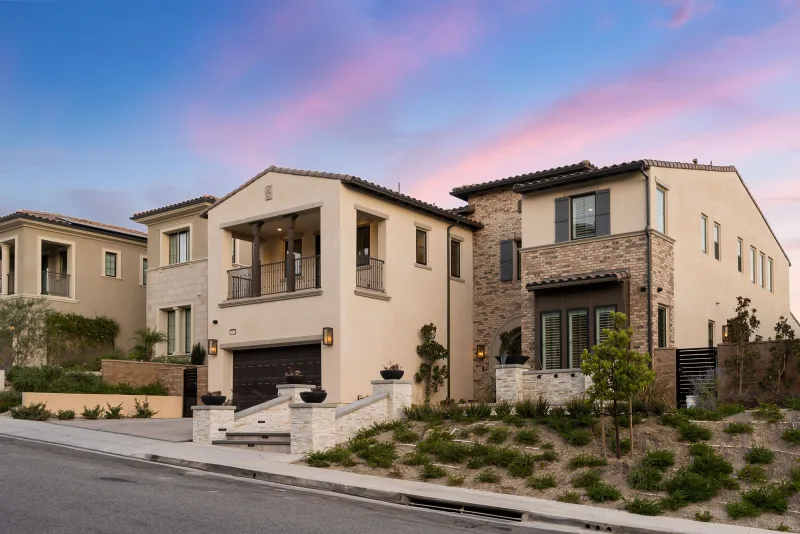
Why Us
Why Choose Washington Elite Stucco for Residential Stucco Services
Washington Elite Stucco is a residential stucco contractor that handles every kind of stucco work a house needs, from a patched crack on one wall to a full recoat of the exterior. That matters more than it sounds, because a company that only performs one type of repair has one answer available when it looks at your wall.
We have no such limit. A bigger job still pays us more, so we are not pretending the incentive vanishes, but we are never pushed toward one answer because it is the only one we sell. The person who determines what your house needs is the same person who will do it, and that removes the pressure that turns a diagnosis into a sale.
We are a licensed stucco contractor with 15 years in the trade, insured with general liability coverage and workers compensation for the crews who work on your property. Over those years we have completed 1,000+ projects.
We work on houses that people are living in, not on empty job sites. Four practices follow, and each one shapes how a week with us goes:
- We look at the wall and determine which system is already on your house before anyone writes a scope.
- We cover and protect the ground, the plants and the surfaces around the work area, and we keep the paths you use every day open.
- We clear debris and tools at the end of each working day, so the parts of your property you are still using do not stay a job site overnight.
- We start every job from a written scope rather than a spoken figure, so you can read what we intend to do before you agree to it.
Those practices cost you nothing to find out about. The estimate is free, and a free estimate is worth having even if you are still deciding whether to do the work at all, because it tells you what is on your wall and what condition it is in. Call us at (435) 319-6039 or send the details through our quote form to book one.
Comparing Stucco Against the Alternatives
Most homeowners want the price settled before they think about anything else, and it is usually asked as a comparison: does stucco cost more than siding, and does it cost more than brick. Published national siding guides put installed stucco at roughly $6.36 to $9.66 per square foot.
The same guides, measuring the same way, put vinyl siding at about $3.16 to $6.13 per square foot. Installed brick veneer, a single course of brick set against the outside of the house as a skin rather than as the structure holding it up, runs roughly $12 to $18 per square foot. Read across those three ranges and stucco lands in the middle, above vinyl and below brick. Those are national averages compiled by cost guides, not our prices, and no house is average.
None of those published ranges can tell you where your own house falls inside them, because the same square foot of wall costs different amounts depending on conditions a guide cannot see. Four of them move the number more than anything else:
- How much wall there is. We calculate coverage by measuring wall area from the elevations, which means determining the actual surface of each face of the house rather than guessing from its footprint.
- How high the wall goes and how easily a crew can reach it. A second story, a steep slope against the foundation, or a narrow side yard all change how the work has to be staged before any material goes up.
- How much has to come off first. A bare wall and a wall carrying a failed surface are two different jobs, and the second one includes taking the old surface down and hauling it away.
- How many openings and edges the wall has. Every window, door, corner and roofline junction is a place where the coating has to be stopped, sealed and finished by hand, so a plain wall and a broken-up one are not comparable even at the same square footage.
That last group of conditions explains the largest gap between the ranges above and what a real project costs. Published national guides place full removal and replacement at $8 to $21 per square foot, a wider and higher band than any of the single-material figures, and again a guide figure rather than a price we have quoted.
The reason is that changing what is on a house means paying twice: once to take the existing surface off and dispose of it, and once for the new wall going up in its place. A homeowner comparing stucco cost against siding cost on a house that already has a finished exterior is looking at both halves, not just the one printed next to the material name.
None of these published figures will be the number on your project, and they are not meant to be. A guide averages thousands of houses across the country, with different wall areas, different heights, different amounts of old material coming off and different labor markets.
Yours has one wall area, one set of openings and one condition, and someone has to measure it. That is what a free estimate is for. Call us at (435) 319-6039 or send your details through our quote form. We will measure the elevations, count what has to come off and what has to be worked around, and give you a figure that belongs to your house instead of to a national average.
How a Residential Job Runs
Every one of our residential stucco services runs through the same four stages, and you meet them in that order every time: a visit, a written scope, a setup around your house, and a walkthrough at the end. The list below says what happens at each one, what we need from you, and what changes about your driveway, your parking and your daily routine while the work is underway.
- We Come Out and Look at the Wall: Someone from Washington Elite Stucco comes to the house and walks the affected walls. The visit costs you nothing, and its purpose is to establish which system is on the wall in person rather than from a photograph. They measure the area to be worked on. That measurement separates a small patch from a full elevation, and it is the number the price is built on. Most visits take under an hour for a single elevation and longer for a whole house. You can help by unlocking side gates, moving vehicles off the driveway, and pointing out a crack that has widened, a stain that comes back after rain, or a spot that sounds hollow when you knock on it.
- You Get the Scope in Writing: Within 24 to 48 hours of the visit, you receive the written scope. It names the surfaces we work on, elevation by elevation, and states which system is going on them. It sets out what comes off the wall first and in what order the rest follows. That turnaround puts the document in your hands while the visit is still fresh. It also gives you something to hold other bids against, because a scope that names surfaces and sequence lets you ask another contractor to price the same list.
- We Set Up Around a House You Are Living In: Stucco is a wet trade, so both overspray and washdown water are part of the setup rather than an afterthought. Before any material goes up we mask windows, doors, light fixtures, outdoor taps and meters, and we cover plants, paving and any stonework. We agree access and parking with you before day one rather than on the morning of it, and you get a scheduled window for the work rather than an open-ended one. We mark the active work zone so it is obviously off-limits at a glance, which matters most for pets and children.
- The Wall Is Finished and We Walk It With You: When the last coat is on, we check the texture and the color against what the scope said they would be, then strip the masking and clear the site. Fresh stucco keeps curing after the crew leaves, so a shade that looks slightly damp or uneven at the edges is the coating still settling, not a defect to report. The job closes with a final walkthrough around the house with you.
To start on the first step, call us at (435) 319-6039 or send your details through the quote form to book a free estimate.
Resale Value and the Appraiser's View of Stucco
Two questions come up whenever a homeowner thinks about stucco and the eventual sale of the house. The first is whether the coating adds anything to home value. The second is whether it puts buyers off. The answers pull in different directions, and both turn on the same thing: an appraiser and a buyer both react to the condition of the wall rather than to what it is coated with.
What the Published Numbers Say About Value
On home value, a published national cost guide puts the share of a stucco installation recouped at resale at about 70 percent, against about 80 percent for vinyl siding. Those are national averages drawn from many markets at once, not an appraisal of your house in Washington, and no percentage from a guide can tell you what an appraiser will write about a specific wall.
Read the two numbers together and the gap looks like a mark against stucco, but a recouped-cost percentage measures a single transaction: money spent one year, money returned the next. Stucco is priced against a service life measured in decades, so a figure that stops at the closing date leaves out the years the coating keeps working.
Vinyl scores well on that measure partly because it costs less to install, which makes the fraction easier to return. The other thing the national average cannot see is what the houses around you are finished in. Stucco is the regional norm across southern Utah, so a stucco house here is not the odd one on the street that a buyer prices down for being unusual.
What a Buyer's Inspector Is Actually Testing For
Buyers on a stucco house often order a moisture inspection alongside the general home inspection, and that second appointment is what makes some sellers nervous.
The inspector is looking for water that has found its way behind the coating and stayed there. A buyer is right to want that checked, because water behind a wall is expensive to put right and cannot be seen from the driveway. The finish itself is not the target, and neither is a hairline crack, which is why a wall that shows a few does not fail on that account.
If you expect to list, you can have the wall assessed while the house is still yours, and then any repair is a job you schedule and price rather than a discovery that arrives mid-negotiation with the buyer holding it. That is the difference between selling a house with a known wall and selling one with an open question on it.
Living in the House While the Stucco Goes On
Residential stucco services put a crew on your walls for days at a stretch while you keep living behind them, and the questions that decide whether that week goes smoothly are rarely the ones about the wall itself.
They are the ordinary domestic ones: when people arrive, when they leave, which side of the house they are on, and what the noise and the water will be doing while your family is inside. We answer those before the first day rather than as they come up, because a household that knows the shape of the week can plan around it, and one that does not spends the week guessing.
Scheduling Around a Southern Utah Summer
Our desert climate runs 100F days from mid-June into early September, and July average highs sit around 102F. A crew can lay stucco through heat like that, but the useful part of the day compresses into its cooler end.
Crews start early and work the shaded elevations while the sun is still off them. They follow the shade around the house as the day turns, so the wall a crew starts at in the morning is often not the one they finish on. Heat and dry wind also pull moisture out of fresh work faster than the material would give it up on its own. The schedule accounts for that in the order the walls are taken and in how much surface is opened at once.
For you, that means summer work looks front-loaded. Vehicles arrive earlier than you might expect, the loud part of the day happens before midday, and afternoons are quieter.
Winters here are mild enough that exterior work carries on through most of them. That gives Washington County a long working season, and gives you more room to pick a start date than a homeowner in a colder state would have. If summer mornings are impossible for your household, or a cooler month suits you better, say so when we talk about dates. We build the schedule around your week as well as around the weather, and the earlier we know which mornings are difficult, the less either of us has to rearrange later.
Where We Work Across Washington County
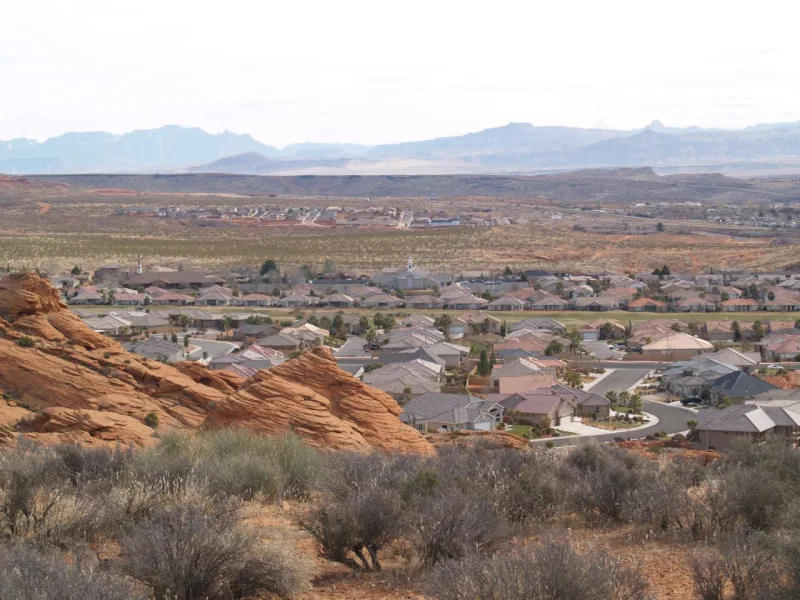
Washington County is not one climate, and a stucco crew that treats it as one will get a wall wrong. The city stands at 2,894 ft on the Mojave Desert's northeastern edge, where the sun hits south and west walls hard for most of the year and monsoon storms arrive in short, heavy bursts.
The high country is a different place. Pine Valley sits at 6,542 ft, and New Harmony, Central, Dammeron Valley and Veyo all stand thousands of feet above the valley floor, with real winters to match. A wall up there works against cold that a wall in Washington Fields never sees. We ask where the house is before we decide what belongs on it, because the answer moves with the elevation.
Communities Washington Elite Stucco Serves
Washington Elite Stucco provides residential stucco services across every community below. You get the same people, the same materials and the same sequence of work wherever the house is:
- Washington, UT
- St. George, UT
- Santa Clara, UT
- Ivins, UT
- Winchester Hills, UT
- Diamond Valley, UT
- Dammeron Valley, UT
- Veyo, UT
- Central, UT
- Pine Valley, UT
- New Harmony, UT
- Leeds, UT
- Toquerville, UT
- La Verkin, UT
- Hurricane, UT
- Apple Valley, UT
- Virgin, UT
- Rockville, UT
- Springdale, UT
Questions Homeowners Weigh Before They Commit
You are probably weighing a few of these already. They are the questions homeowners ask us most often before they commit, and the answers below are short and honest.
Is it cheaper to stucco or siding a house?
Vinyl siding costs less to install. Published national siding guides put vinyl at roughly $3.16 to $6.13 per square foot installed, against roughly $6.36 to $9.66 per square foot for stucco, so on the day the invoice arrives vinyl is the smaller number. The gap narrows over the years you own the house, because vinyl panels reach the end of their service life and get replaced while a maintained stucco wall stays where it is.
Is it cheaper to brick or stucco a house?
Stucco is the cheaper of the two. Published national guides put installed brick veneer, the single layer of brick built against the outside of a house rather than holding it up, at roughly $12 to $18 per square foot, while stucco runs about $6.36 to $9.66. Both materials last decades when they are built and maintained properly, so the higher price is not buying you extra years. That leaves the look you want and the condition of the wall underneath to decide between them.
Does stucco add value to a house?
Partly, and less than most owners expect. A published national cost guide, not a figure of ours, puts roughly 70 percent of stucco spending coming back at resale. That leaves you down on the outlay. Condition moves that number far more than the material does: clean, matched repairs and no staining support the price, while open cracks and mismatched patches invite a negotiation.
What are the disadvantages of a stucco house?
Four are worth knowing before you commit. Stucco develops hairline cracks, and repairs can stay visible on a wall the sun has faded. Water that finds a path in behind it is slow and costly to put right. It is not a material a homeowner can apply over a weekend. The cracking alarms people most, though a rigid coating on a house that shifts slightly with heat, cold and settling will show that movement as a thin line. That is the material reporting what the building did, not the material failing.
Why is stucco not used anymore?
It is. Stucco remains the regional norm for residential exteriors across Washington County, and new houses go up with it every year. What fell out of favor was a different class of cladding system, one built so that water finding its way behind the surface stayed there against the sheathing. One word, synthetic, gets sold on both an acrylic finish and a complete insulated cladding system, which is how the two get mistaken for one another, and why we identify what is on the wall before quoting anything.
Should I avoid stucco homes?
No. Inspect them on the right terms instead. What an inspector is looking for is water behind the coating, not the appearance of the coating itself, because a wall can look sound from the sidewalk while the framing behind it holds moisture. A moisture inspection ordered alongside the general home inspection is a reasonable thing to ask for and costs very little measured against what you are paying for the house.
Is it worth replacing stucco with siding?
On cost alone, usually not. Switching materials means paying twice on the same wall, once to strip the old coating off and haul it away, and again for the new covering that goes on after. Published cost guides put stucco removal and re-stucco at $8 to $21 per square foot of wall, and those are guide figures rather than our pricing. Swapping to siding is a different job. You still pay to strip the stucco off, which is most of that range, but the covering that replaces it is siding, and siding costs about half what stucco does to install. The switch earns its keep when the wall behind the finish is the reason, not the finish itself.
Talk Through Your Home's Wall
A free estimate is a visit, not a sales call. Washington Elite Stucco comes to your house, looks at the wall itself, and tells you what we find, then puts a written scope behind it. Call (435) 319-6039 or send the quote form for residential stucco services anywhere in Washington County.